 |
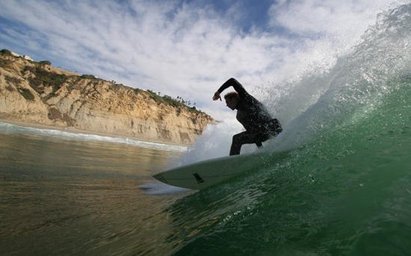
| A surfer at Black's, with cliffs in background |
Black's Beach was named for the Black family who had a horse farm overlooking the beach. They sold the land, and then it was subdivided into La Jolla Farms lots. The Farm's residents retained the Black family’s private road to the beach.
A submarine canyon funnels swells into Black's Beach, making it appealing to surfers but dangerous for inexperienced swimmers.
LOCATION
Black’s Beach is located about three miles north of the popular La Jolla Shores beach in La Jolla, San Diego, California, below the bluffs of Torrey Pines, which extend up to 300-foot (91 m) above the sandy beach. On the bluffs above Black’s Beach are the Torrey Pines Gliderport, Torrey Pines Municipal Golf Course, Salk Institute for Biological Studies, and Torrey Pines State Reserve. To the north of Black’s Beach lies the rest of Torrey Pines State Beach, which altogether stretches 4.5-mile (7.2 km) from Del Mar, California, past the Los Peñasquitos Lagoon toward Scripps Beach in the south. The beach is near the Scripps Institution of Oceanography and the University of California, San Diego and is popular with the students of the university for sunbathing and surfing. Many students can be seen walking from the university to Black's.Nude beach
Black's Beach in San Diego is perhaps the largest nude beach in the United States and is popular with Southern Californian nudists and naturists. Because Black's Beach was traditionally recognized as a clothing optional beach, nudity is tolerated for the portion of the beach that is managed by the state park. Nudity has been prohibited on the city portion of Black's Beach since 1977. Prior to 1977 the city posted it as a "swimsuit optional" area.
The clothing optional portion of Black's Beach begins about 100-yard (91 m) south of the trail head leading to the Torrey Pines Gliderport, and runs north for approximately 1.1-mile (1.8 km) to the steel buoy south of Flatrock.
Surfing
he southern portion of Black's Beach is known to surfers as one of the most powerful surf breaks in Southern California. The waves gain their power due to the focusing effects of Scripps Canyon, an underwater canyon just offshore in the San Diego-La Jolla Underwater Park. Because of the sometimes large surf, fast breaking waves, and aggressive crowds, Black's is a dangerous surfing location, advisable for advanced surfers only.
Access
Black’s Beach can be difficult to access due to its remote location beneath the Torrey Pines bluffs. There are four access routes to Black’s Beach.
Torrey Pines Gliderport Trail – the most popular route to Black’s Beach is via the trail from the Gliderport, located between the Torrey Pines Gliderport and the Salk Institute for Biological Studies. This steep rugged trail down the 300-foot (91 m) cliffs is usually well maintained by advocates of the beach, but the city of San Diego posted a “Do Not Use” sign there, as the Torrey Pines cliffs are unstable.
Salk Canyon Road from UCSD – Students from the University of California, San Diego have access to this steep, 1⁄2-mile (0.80 km) long gated paved road at the southern end of Black’s Beach, which is popular with surfers. The clothing optional portion of the beach begins 1⁄2-mile (0.80 km) north of this access point.
Torrey Pines State Beach – If the tide is low, a 2-mile (3.2 km) walk south from the parking lot at the base of Torrey Pines State Reserve, along the steep cliffs, and past Flatrock will get you to Black’s Beach. The route is blocked at high tides.
La Jolla Shores – If the tide is low, a 3-mile (4.8 km) walk north from La Jolla Shores beach, past Scripps Pier and the rocky tidepools of Scripps Beach will get you to Black’s Beach. The route is blocked at high tides.
Source: http://en.wikipedia.org/wiki/Black's_Beach

0 comments:
Post a Comment